


The Exposition Universelle opened in Paris in April 1900 and closed in November, and it drew something close to fifty million admissions. For Art Nouveau that run mattered more than any gallery show of the previous decade. Until then the style lived in a few Paris shops, a handful of Brussels townhouses and a stack of illustrated journals with small subscriber lists. After the fair it belonged to anyone who walked through the gates.
The fair did two things at the same time. It put the style in front of a mass audience, and it gave manufacturers a reason to tool up for it. Glass from Nancy, furniture from Paris, jewellery from the Rue Royale and metalwork from Belgium all sat inside one visual argument, which made the argument look settled. A style that reaches production scale stops being a position and becomes a catalogue.
The pavilion that did the selling
Siegfried Bing opened his Paris gallery, the Maison de l'Art Nouveau, in December 1895, and the shop handed the style its name. At the fair he built a pavilion of furnished rooms rather than a display of separate objects. Visitors walked through interiors designed as wholes by Georges de Feure, Eugene Gaillard and Edouard Colonna. The room, not the vase, was the unit on offer.
That decision changed the price conversation. A single lamp competes with every other lamp on the market, while a coordinated interior competes with nothing, because the client either buys the scheme or walks away. Architects had made the argument before, and the fair made it commercial. Within two years the same logic turned up in Vienna, Glasgow and Darmstadt, always with a workshop attached to it.
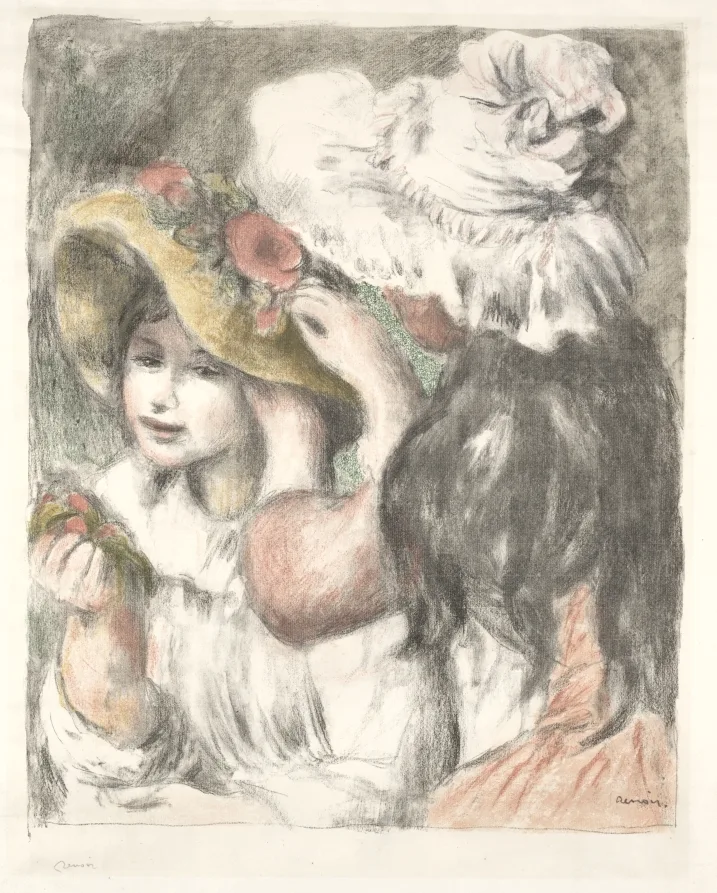
Print handled the rest of the distribution. Colour lithography had matured through the 1890s in the hands of printers such as Auguste Clot, and a poster or an album page could carry the whipping line and the flat colour to a buyer in Lyon or Leeds. Journals reproduced the fair displays for readers who never travelled. The style spread as printed matter first and as objects second.
- Bing sold furnished rooms rather than single pieces, which raised the size of an average order
- Galle and Daum showed glass from Nancy, where a regional industry had already retooled for the style
- Guimard's Metro entrances went up the same year, which put the vocabulary on the street for free
- Lalique showed jewellery that treated horn and glass as seriously as stones, so price followed design rather than material
- The Grand Palais and the Petit Palais were built for the fair and stayed, giving Paris two permanent halls
- Illustrated journals reproduced the displays, so provincial makers could copy the vocabulary within a season
Commercial results were uneven, and that part usually gets left out. Bing spent heavily on the pavilion and the return arrived as reputation rather than as receipts, which he then converted slowly through the shop. Several Nancy firms did better, because they were selling repeatable production instead of one-off interiors. The fair rewarded whoever could manufacture.
What wide exposure did to prices
Reach cuts both ways. Demand rose fast enough that commercial glassworks began pressing versions of the same idiom at a fraction of the studio price, and the cheap version arrived within a couple of years. Buyers who had paid studio prices found the style sitting in department store windows. By 1905 the term had lost its edge in Paris, although the objects kept their buyers and their makers kept working.
A world fair does not invent a style. It settles the argument about whether the style exists, and it hands buyers a catalogue and a price.
Beautiful Art editorial note
For anyone collecting this period, the fair works as a dividing line. Objects made before 1900 mostly come from small workshops and carry marks that can be traced, while objects made after it exist in studio and factory versions at once, and the gap between the two is where most misattributions live. Ask who made a piece before you ask what it looks like. Comparable holdings sit in The Metropolitan Museum of Art if you want a baseline for quality.
