


Hyperrealism is art that renders its subject with more detail and clarity than the photograph it was made from. It covers painting, drawing and sculpture. The finish is deliberately impersonal, the scale is often larger than life, and the labor involved is meant to register. If a picture makes you check whether it is a photograph and then makes you realize a photograph could not look like that, you are probably looking at hyperrealism.
The style emerged in Europe in the early seventies out of American photorealism. A 1973 exhibition in Brussels gave it the name, and the word spread through European galleries while American writers kept using the older term. The two words now describe overlapping bodies of work, with hyperrealism generally applied to the later and more extreme end.
How it differs from realism
Realism describes the world as an observer might see it, with the softness and the selective focus that come with looking. Hyperrealism refuses that softness. Everything in the picture holds the same level of resolution, which is a condition that neither the eye nor the camera produces on its own. The effect is unnatural precisely because nothing in it looks unnatural.
Traditional realists also accept accidents. A brush that runs dry, an edge that stays rough, a passage left thin: these are part of how a realist painting communicates. Hyperrealist work removes them systematically, and the removal takes most of the time the picture consumes.

The illusionistic instinct is much older than the style. Greek writers told stories about painted grapes that fooled birds, and Dutch and American painters built entire careers on trompe l'oeil objects that seemed to project from the surface. Hyperrealism belongs to that lineage and adds the camera as an intermediary. What changed is the source, not the ambition.
- Uniform sharpness across the whole surface, with no falloff toward the corners
- Scale that exceeds life size, often by a factor that only becomes clear up close
- Surfaces that reward the technique: glass, chrome, water, wet skin, plastic wrap
- Invisible brushwork at reading distance, with the marks appearing only under inspection
- A neutral emotional register, since the drama comes from the detail rather than the pose
Those five signs appear together in most hyperrealist work and rarely appear together anywhere else. Any one of them on its own means little. A very sharp small painting is just a sharp small painting.
Sculpture follows the same rules with one addition, which is that the surface has to hold up from every angle. Hanson and Mueck build skin from silicone and polyester resin and set individual hairs by hand, and the work reads as a person until the viewer notices the stillness. Cast figures also age differently than paint, and a resin surface that has yellowed cannot be cleaned back to where it started.
Names to start with
Chuck Close, Richard Estes and Audrey Flack established the American foundation, and Duane Hanson moved it into cast figures that people mistake for gallery visitors. Ron Mueck is the best known sculptor working this way now. Among painters, Roberto Bernardi handles glass and reflective surfaces, and Pedro Campos does the same with everyday packaging.
For a buyer the practical question is what happens to the work over time. Hyperrealist surfaces are thin and even, which makes them stable but unforgiving, since any later retouching shows immediately under raking light. Ask for condition photographs taken at an angle rather than head on, because a flat image hides exactly the damage that matters here.
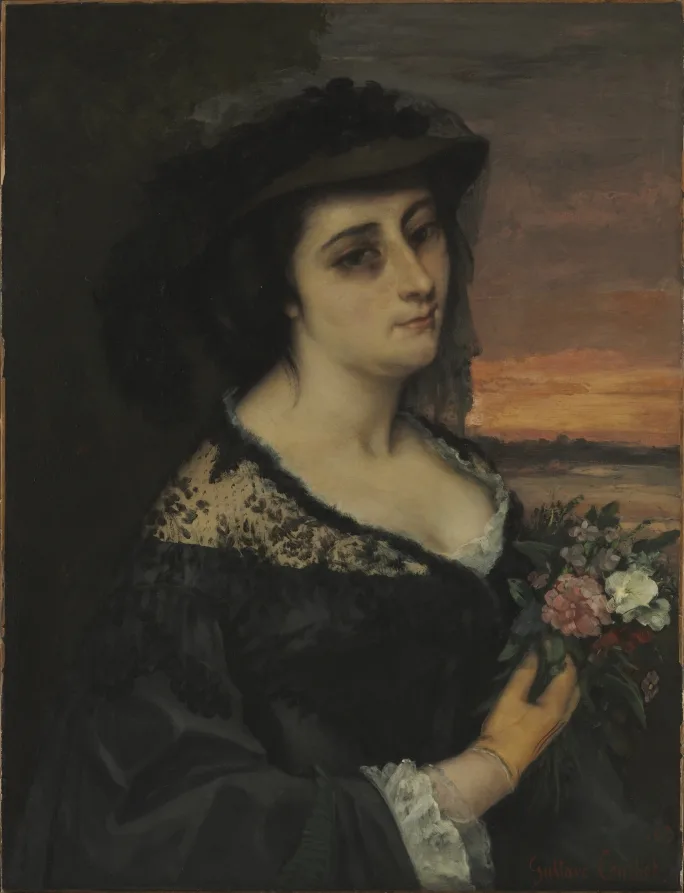
I have never seen an angel. Show me an angel and I will paint one.
Gustave Courbet, painter
Courbet said that in response to a request for a religious painting, and it remains the shortest statement of the realist position. Hyperrealism keeps his rule about visible subjects and abandons his interest in how a painting should feel to make.
